
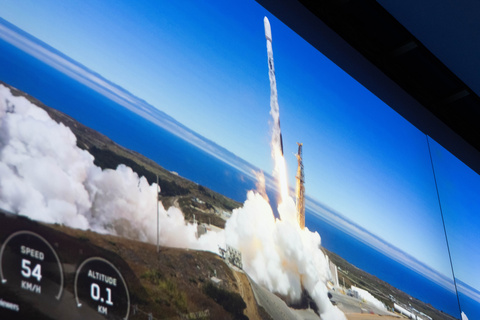
On July 23, 2025, at 11:15 a.m., the TRACERS mission launched a rocket containing two satellites designed to orbit Earth and study the magnetic fields of the Earth and sun.
While researchers at the University of Iowa and across the country will analyze and study data produced by the satellites, IT staff from the College of Liberal Arts and Sciences and Information Technology Services will support approximately 30 systems devoted to this project. These may only be a small subset of the devices and technology required for a mission of this magnitude, but they’re necessary for a vital component: gathering data from the satellites.
Brad Carson, senior systems administrator, leads the security and research compliance aspects of TRACERS. Since the project is funded by a NASA grant, it must comply with regulations set by the federal government to address security of systems and hardware and separation of duties.
“We get a unique glimpse into the sheer number of things that must be coordinated to put anything into space, communicate with it, and get data back from it,” says Carson. “The enormity, complexity, and time required are amazing when you see it up close. I don’t know how to describe it outside of amazing.”
Jeff DeReus, senior systems administrator, supports the physical hardware, operating systems, software deployment, and overall configuration of the systems supporting TRACERS. His work ensures that the system is stable, reliable, and can adapt to additional needs—for example, reconfiguring a virtual machine to allow for more memory or monitoring and replacing aging hardware.
“We get to work on the backend of an incredible project,” says DeReus. “I’ve learned so much. Even the small facts are interesting, like how long it takes data transfers to travel from space.”
Collaboration is key
This project wouldn’t be a success without OneIT partners.
“Each department that is working on TRACERS recognizes the importance of the project,” Carson says. “And they’ve all done an excellent job of making sure things function appropriately.”
The satellites collect data and send it back to Earth, where it will be stored in large scale storage, and some data is already available to the public. This requires the team to connect large scale storage to a web server, which is an Information Technology Services virtual machine. The project will even use the university’s high-performance computing resource, Argon, to complete modeling with the data.
“The responsiveness and understanding from IT support, from changes to virtual machines to storage modifications, has been great,” says DeReus. “We collaborate effectively to resolve requests quickly so the researchers can do their work.”
They also consult with ITS Research Services and the Information and Security Policy Office when needed and to complete an annual review of security documents.
“While they’re all separate entities, whether that’s a department or a service, the interconnectivity and collaboration are vital for TRACERS,” says DeReus. “It’s another part of the University of Iowa’s history with space exploration, and we get to work on a project that continues that legacy.”