What is an IT Service?
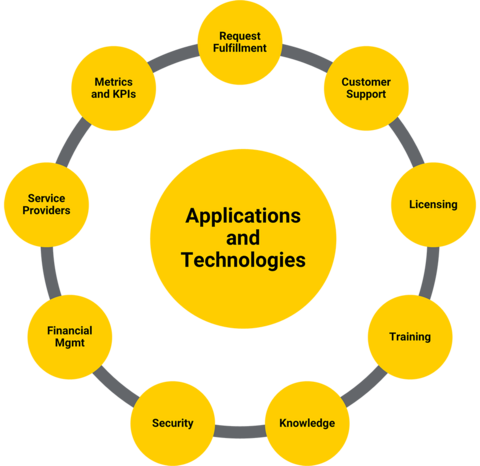
An IT service is a combination of people, processes, and technology designed to deliver specific outcomes that support business operations. Services typically include one or more of the following components:
- Applications and Technologies: applications, hardware, and infrastructure that typically form the foundation of the IT service. Includes servers, cloud services, authentication, etc.
- Customer Support: support for customers including incident management, how to, communication around service updates, etc.
- Licensing: acquiring, maintaining, and managing the licensing needed to deliver a service.
- Training: resources to help users effectively utilize the service (e.g., quick start guides, videos, instructor-led classes, etc.)
- Knowledge: documentation for end-users, support staff, and service owners on how the service is configured, how it works, etc.
- Security: measures to protect data, people, and systems from threats (e.g., firewalls, encryption).
- Financial Management: overseeing of the financial aspects of a service including hardware and software costs, vendor costs, staff time, etc.
- Service Providers: various groups and individuals responsible for delivering different aspects of a service. The service owner is responsible for coordinating all service providers involved in delivering a service.
- Metrics and KPIs: data, reports, and metrics used to monitor, manage, and oversee a service. May be internal and/or shared externally with customers.
- Request Fulfillment: process that allows customers to request a service and for IT to successfully fulfill that request in a timely and efficient manner.
Best practices when defining a service
- Start with the customer’s perspective or outcome. Define the service based on the value and outcome it provides to the end user (faculty, staff, students, etc.). Remember other IT staff can be consumers for internally focused IT services.
- Define service boundaries clearly and in a way that makes sense. It is best to define a service for email that includes the Microsoft 365 component, the web interface, mobile apps, spam protection, etc., as opposed to defining each of those as a separate service.
- Define scope. Be explicit about what the service includes and what is does not include.
An IT service is not
- A product alone
- A technology component
- An activity or one-time task
- The act of providing support
- A team or individual
- A project

